Using Bayworks
How Bayworks helps write warranty stories
Say what happened. Keep the evidence in the finished story.
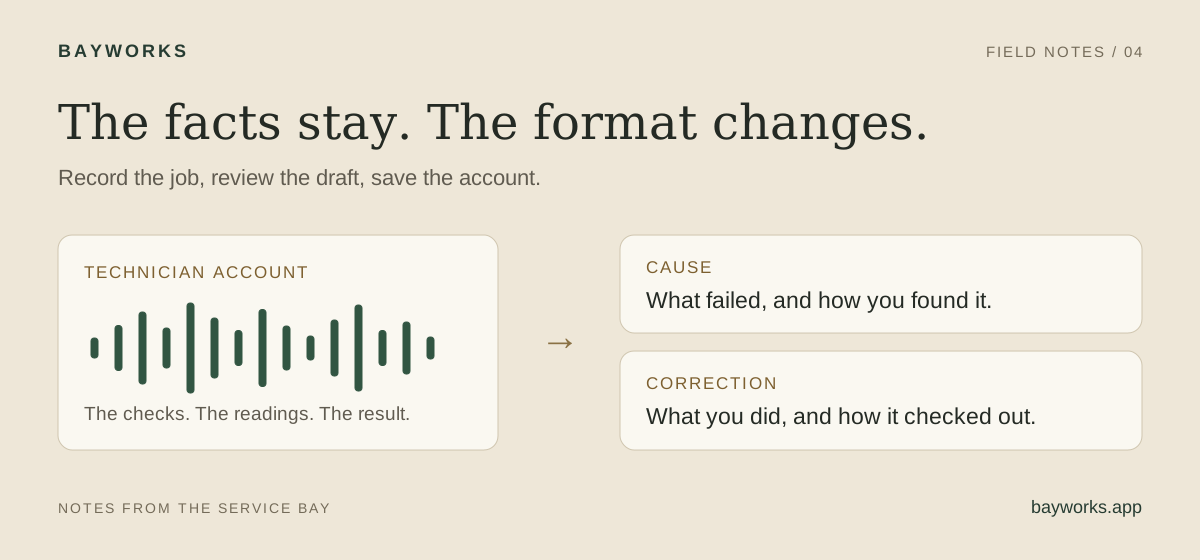
The road test is finished. The brake squeal is gone. You still have the pad measurement, rotor reading, and torque values in your head, but the next RO is already waiting.
This is the moment a complete repair becomes an incomplete note. "Pads and rotors. Good now." Tomorrow, someone asks what the rotors measured.
Bayworks gives those details somewhere to go while they are fresh.
Speak through the job, then check the record
Describe the job in the order you remember it: the symptom you duplicated, the checks you ran, what failed, the repair, and the final test. You can use ordinary shop language. You do not have to dictate punctuation or compose the final paragraph before speaking.
Cause and correction can be recorded separately. That matters when diagnosis finishes today and the part arrives tomorrow. The cause records the finding and recommendation; the correction records completed work. A part on order should stay a part on order.
Bayworks can ask focused questions for missing details. Answer with what you observed or measured. If you do not have a reading, do not supply a plausible number. A clean sentence cannot make an unknown value true.
Review happens before the account becomes the working record. The technician supplies the facts; the draft makes them easier to read.
A brake job, before and after
This fictional adaptation uses the brake scenario from our homepage demo. The spoken account combines the initial recording and follow-up answers. Its readings, minimum thickness, and torque values are illustrative and must not be reused as another vehicle's specifications. Brake wear alone does not establish warranty coverage.
The weak note discards the diagnosis. The reviewed version retains the low-speed squeal, the measured wear, the repair, and the symptom-specific retest. There is no invented DTC for a mechanical finding.
- Before: weak note
- BRAKES NOISY. DID PADS AND ROTORS. OK NOW.
- Technician recording and answers
- Road tested it and got the customer's front brake squeal below 30 mph. Lifted it, pulled both front wheels. Pads at 2 mm, wear indicators touching the rotors. Both front rotors heavily grooved, measured 22.5 mm against the 23 mm minimum. Replaced both front pads and rotors. Bracket bolts at 110 Nm, wheel nuts at 108 Nm. Drove 5 miles, repeated the braking below 30. No squeal, brakes smooth. Final function check was normal.
- Cause draft
- VERIFIED CUSTOMER CONCERN OF FRONT BRAKE SQUEAL WHILE ROAD TESTING AND BRAKING BELOW 30 MPH. RAISED VEHICLE AND REMOVED BOTH FRONT WHEELS. INSPECTED FRONT BRAKES AND FOUND PADS WORN TO 2 MM WITH WEAR INDICATORS CONTACTING THE ROTORS. BOTH FRONT ROTORS HEAVILY GROOVED AND MEASURED 22.5 MM AGAINST THE STATED 23 MM MINIMUM. RECOMMEND REPLACE FRONT BRAKE PADS AND BOTH FRONT ROTORS.
- Correction draft
- REMOVED WORN FRONT BRAKE PADS AND BOTH BELOW-MINIMUM FRONT ROTORS AND INSTALLED NEW FRONT PADS AND ROTORS. TORQUED CALIPER BRACKET BOLTS TO 110 NM AND WHEEL LUG NUTS TO 108 NM. ROAD TESTED 5 MILES, INCLUDING BRAKING BELOW 30 MPH; SQUEAL NO LONGER PRESENT AND BRAKING SMOOTH. PERFORMED SYSTEMS FUNCTION CHECK. ALL OPERATION NORMAL AS FACTORY DESIGN.
Three shortcuts to catch in any draft
1. A number loses its meaning. "Twenty-two point five" could become a rounded value or lose its units. Fix: compare technical values against your recording and notes. In this example, 22.5 mm and the stated 23 mm minimum belong together.
2. A recommendation becomes completed work. The technician describes what should be replaced, but a reader thinks it already happened. Fix: read the verbs. Keep "recommend" in the cause until the repair is performed, then record the actual work in correction.
3. The closing sentence outruns the test. A general function-check phrase appears without a useful account of how the original symptom was checked. Fix: retain the road-test conditions and observed outcome. If the concern persists, say so. If the vehicle is awaiting parts, leave the job open.
These are review habits for any writing method. Typing, templates, and speech all need the same attention to the facts.
| Detail | Value in the example | Review question |
|---|---|---|
| Initial finding | 2 mm pads; 22.5 mm rotors | Are the locations, units, and stated minimum retained? |
| Completed work | Front pads and both front rotors | Does this match the work actually performed? |
| Verification | 5 miles; braking below 30 mph | Does the draft record no squeal and smooth braking? |
Time the saved story, not the first draft
Try the workflow on a small set of similar jobs. Start the clock when documentation begins and stop when the reviewed story is saved. Include corrections and follow-up, not just the recording.
For a hypothetical pilot, assume eight stories a day take two fewer minutes each. That is 16 minutes per technician per day. Across six technicians and 22 days: 16 × 6 × 22 ÷ 60 = 35.2 hours. These are planning assumptions, not measured Bayworks performance.
At an assumed $35 loaded staff-hour cost, that represents $1,232 of time value. It is not automatically a payroll reduction or extra revenue. Check whether the time becomes more completed work, less overtime, or an earlier finish to the day.
Have the warranty administrator review the sample too. A fast draft that creates another clarification call has moved the work rather than removed it.
A review card for the next recording
Copy this beside your workstation. Use the same routine whether the repair is a simple mechanical finding or a longer diagnosis with codes and readings.
Before using the Bayworks draft
Select and copy this checklist into your shop notes.
[ ] Vehicle, RO, and repair line match the job described.

[ ] Verified concern reflects the actual conditions tested.

[ ] Diagnostic checks, readings, units, and component locations are accurate.

[ ] Cause separates findings and recommendations from completed repair.

[ ] Correction includes the exact work and the final verification result.

[ ] No unfamiliar fact or unsupported successful outcome remains.

[ ] Reviewed story reaches the correct DMS fields and is saved.
Reference: Watch the Bayworks recording and review workflow.
Common questions
Does Bayworks diagnose the vehicle?
The story workflow documents the technician's diagnosis. The technician performs the checks, supplies the findings, and verifies the draft. A writing tool is not a substitute for service information or a diagnostic procedure.
Can I record the cause before doing the repair?
Yes. Cause and correction can be recorded separately. Capture the diagnosis when it is complete, then document the correction after the work is done.