Fixed operations
How to improve service bay revenue
A full parking lot is not a full day of billable work.
There are cars in every space outside service. Two wait for authorization, one needs a backordered part, and another is repaired but cannot close because the story is unfinished.
The appointment board looks healthy. The closed-RO report tells a different story.
Before buying another lead, follow one vehicle all the way to the invoice.
Work the math before adding a bay
Start with labor sales divided by labor hours sold. That is effective labor rate, or ELR. Calculate it separately for customer-pay, warranty, and internal work. A shift toward a different pay type can move the blended rate even when nobody changes a price.
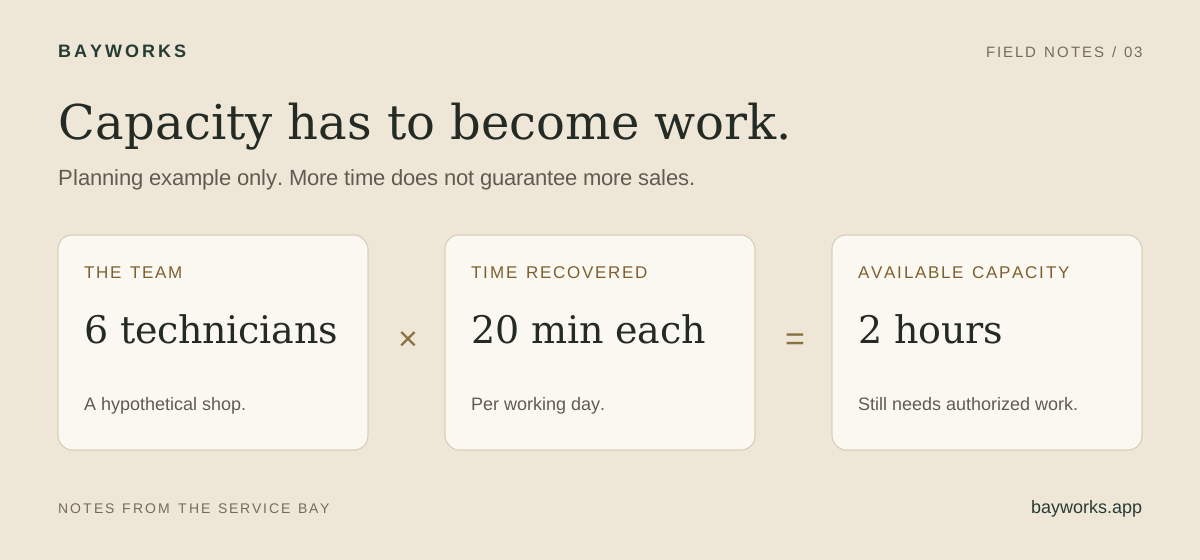
Consider a hypothetical shop with six technicians. Recovering 20 minutes per technician per day produces 120 minutes, or two hours of capacity. Assume those become two additional sold hours at a $150 ELR: two × $150 = $300 in labor sales per day. Across 22 days, that is $6,600.
This is an estimate, not a Bayworks result or industry average. At a 50% conversion from available time to sold work, the same calculation yields $3,300. With no additional authorized demand, it yields no additional sales. Wages, parts costs, and overhead still separate sales from profit.
NADA recommends reviewing ELR with technician performance, throughput, and days to complete. Together, those numbers help show whether the next improvement belongs in dispatch, pricing, or the handoff after repair.
Reference: NADA: How do I fix my service department?.
Four places completed work gets delayed
1. An occupied bay has no next action. The car is waiting, but nobody owns the next call. Fix: label the hold as parts, approval, diagnosis, or documentation and assign a person and next update time. Move the vehicle when it is safe and useful to do so.
2. The inspection has a color but no finding. "Brakes red" gives the advisor little to explain. Fix: capture the location, measured condition, applicable limit, and recommendation. A photo helps when it clearly shows the measurement or damage being discussed.
3. The finished repair cannot be billed. A missing result or unresolved labor question sends the administrator back to the technician. Fix: review the cause, correction, required records, and approved work before the line leaves the bay. A readable story supports legitimate billing; it does not establish coverage by itself.
4. Declined work disappears. The customer leaves with a vague suggestion and nobody knows what to follow up. Fix: retain the finding, estimate, reason for declining when provided, and agreed contact timing. Recommend work based on condition and need, not on a target dollar amount.
Give the advisor a finding they can explain
Use the correct vehicle procedure for every decision. The references below show why a measurement needs context. They are not a universal red/yellow/green policy, and the brake bulletin applies only to its listed vehicles and conditions.
| Item | Published reference | What to record |
|---|---|---|
| Tire tread | NHTSA: replace at 2/32 inch. | Depth and position for each tire, plus uneven wear or damage. |
| Brake pads | GM PIT5377G: within 2.0 mm of the mounting plate for the covered brake-pad condition. | Actual inner/outer pad readings, axle and side; check current vehicle-specific service information. |
| 12-volt battery | Interstate: a charged car battery should measure 12.6 V or higher. | Voltage and test conditions, then the appropriate battery test result. Voltage alone does not establish battery health. |
Reference: NHTSA TireWise: tread depth.
Reference: GM PIT5377G, April 2019, archived by NHTSA.
Reference: Interstate Batteries: battery FAQs.
Show what the recommendation rests on
A weak handoff says "needs tires." A useful handoff names the affected tire, records its measured tread depth and condition, explains the recommendation, and includes the estimate. The advisor can then show the customer what was found instead of asking for trust in a colored box.
Keep inspection findings separate from customer-reported symptoms. A tire discovered during an inspection does not become a verified customer complaint. Keep urgent action, future maintenance, and items to monitor distinct, using the relevant service guidance.
Ask for authorization before additional work starts. A stronger explanation should help the customer make a decision, including a decision to decline. It should not turn an uncertain observation into a confident diagnosis.
For the documentation side of the handoff, use a short review routine that checks evidence and outcome before the technician moves on.
Bring five questions to the weekly meeting
Use this card on a small sample of delayed ROs. Compare similar weeks and keep the pay mix visible. The point is to choose one fix the team can make, not to build a report nobody opens.
If sold hours improve while repeat repairs or returned stories increase, investigate before expanding the change. More billing this week is not a good trade for avoidable rework next week.
Weekly service revenue review
Select and copy this checklist into your shop notes.
[ ] How many hours sold, and at what effective labor rate, for each pay type?

[ ] Which ROs waited longest, for what reason, and who owns the next action?

[ ] Which finished repairs waited on documentation or clarification?

[ ] Did declined recommendations retain a finding, estimate, and follow-up plan?

[ ] Did gross margin, repeat repairs, or customer concerns change with throughput?
Common questions
Will more appointments increase service revenue?
Only if the shop can complete the work. If dispatch, parts, or approvals are already limiting output, extra appointments may increase waiting time without increasing completed hours.
Is revenue per RO enough to judge performance?
No. Job mix can change that number substantially. Review it with completed hours, effective labor rate, margin, cycle time, and repeat repairs to understand the result.