Shop productivity
How to improve technician efficiency
Find the lost minutes before asking for faster repairs.
At 10:20, the lift is occupied and the technician is standing at the parts counter. The advisor is waiting for an estimate. Dispatch has another job ready, but nobody has decided whether the first vehicle can move.
By lunch, the report will show a slow morning. It will not show the three people waiting on each other.
Start with the waiting.
Three numbers, three different questions
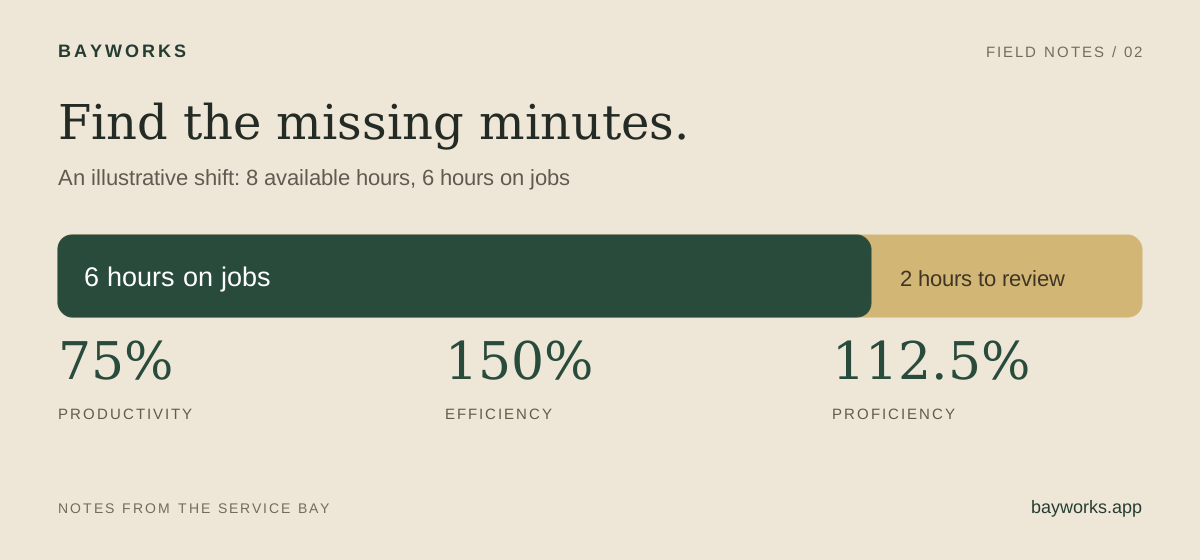
A technician available for eight hours spends six hours on jobs and produces nine flat-rate hours. Calling that person either "75% efficient" or "150% productive" muddles two different problems.
NADA separates productivity, efficiency, and proficiency as shown below. Check your DMS definitions before comparing reports. Shops sometimes use the same label for different calculations.
The example technician already produces work quickly while on a job. The two hours outside job time deserve a closer look. Training, breaks, meetings, and essential support work may explain some of them; avoidable delays may explain the rest.
| Measure | Calculation | What it shows |
|---|---|---|
| Productivity | 6 job hours ÷ 8 available = 75% | How much available time reached jobs. |
| Efficiency | 9 produced hours ÷ 6 job hours = 150% | Output during time spent on jobs. |
| Proficiency | 9 produced hours ÷ 8 available = 112.5% | Output across the available shift. |
Reference: NADA: Service Department Performance Analysis, technician performance.
Four ways a ready technician gets stuck
1. The job arrives before the parts. A booked repair reaches the lift with an incomplete kit or a part that is still on a truck. Fix: verify the physical parts and required hardware before dispatching known work. Diagnostic jobs need their own plan because the required part is not yet known.
2. The concern is too thin. "Noise" sends the technician searching across speeds, temperatures, and road surfaces. Fix: capture when it happens and what the customer hears. A cold-start concern needs a cold vehicle. Agree on that before someone warms it up moving it through the lane.
3. Approval has no owner. The estimate is ready, but the technician keeps checking whether anyone called. Fix: give the advisor a clear request, expected response time, and way to send the decision back. Dispatch decides the next job while authorization is pending.
4. The story waits until closing time. Six finished repairs become six memory exercises. Fix: record the diagnosis when it is fresh and the correction after the repair. Keep the readings and final check with that line, so nobody has to reconstruct the sequence later.
For a week, record the stop reason and approximate minutes on a small sample of jobs. Count patterns rather than grading individual people. A parts delay repeated ten times is more useful to investigate than an argument about one slow afternoon.
Give dispatch a release checklist
The next job should be ready when the current one stalls. That does not mean filling every bay with a disassembled vehicle. Agree on which cars can safely move and which work requires the same technician to continue.
Use this card for planned repairs. For diagnosis, replace the known-parts check with a clear diagnostic authorization and the tools needed to investigate. One person should own the answer to each item.
Before the job reaches the bay
Select and copy this checklist into your shop notes.
[ ] Concern includes the symptom and the conditions needed to reproduce it.

[ ] Authorized scope and contact for any additional approval are clear.

[ ] Required parts and hardware for the planned repair are physically available.

[ ] Service information, special tools, and suitable equipment are accessible.

[ ] Technician assignment fits the job and any required training.

[ ] Next action and owner are recorded if work must pause.

[ ] Cause, correction, and final check will be captured before closing the line.
Twenty minutes is capacity. Sell it before counting it.
Here is a planning estimate: six technicians recover 20 minutes each per day by reducing repeated status checks and story rework. Six × 20 ÷ 60 = two available hours a day. Across 22 working days, that is 44 hours.
If the shop turns each recovered hour into one additional sold hour at a $150 effective labor rate, the illustrative upside is 44 × $150 = $6,600 in monthly labor sales. That assumes enough authorized work, parts, and dispatch capacity. It also assumes a one-to-one conversion from recovered time to sold time.
If only half becomes sold work, the estimate is $3,300. Neither figure is profit. Include labor cost, tool cost, and any overtime before making a purchasing decision. A shorter documentation task can still be worthwhile when it reduces end-of-day catch-up without creating another appointment.
Run a pilot the team can trust
Pick one repeatable change, such as parts confirmation before dispatch or recording the cause immediately after diagnosis. Compare similar repairs over a baseline week and a pilot week. Keep staffing and job mix visible so a week of easy maintenance does not get credited to a new tool.
Measure elapsed time through the saved story, not just wrench time or the moment a draft appears. Ask the advisor how many notes came back for clarification. Ask the technician whether a delay disappeared or simply moved to a different screen.
Set local guardrails before starting: for example, review every story missing a verification result and every repeat repair in the sample. Those are pilot rules, not universal performance benchmarks. Keep the change only if the time improvement survives that quality review.
Bayworks can help with recording and formatting the account. Parts readiness, dispatch decisions, and accurate time records still need a person who owns them.
Common questions
Can technician efficiency exceed 100%?
Yes. When efficiency means flat-rate hours produced divided by actual job hours, a technician who produces six hours in four job hours is at 150%. That number does not show how much of the shift was spent waiting.
What should we change first?
Start with the most common avoidable delay in your own shop. Parts readiness, clearer concerns, or fewer documentation handoffs may offer more than a general instruction to work faster.